




ORGANS OF PARIS © 2026 Vincent Hildebrandt HOME ALL ORGANS



Until the Second Empire came to power, Clignancourt was
only a small country village north of Paris. For worship, its
inhabitants belonged to the church of Saint-Pierre de
Montmartre. In 1853, the villagers asked for permission to
build a new church, and this was approved in 1858 by the
Paris City Council. The foundation stone was laid in May
1859. The building, in a neo-Romanesque style, was
entrusted to the architect Paul-Eugène Lequeux
(1806–1873).
In 1863, an imperial decree created the new parish, whose
church is dedicated to Our Lady of the Immaculate
Conception of Clignancourt. During the Commune, the
church was sacked.
Although it suffers from a slight lack of light, the church
has very beautiful paintings by renowned artists (Félix-
Joseph Barrias, Michel Dumas, Romain Cazes). Its choir,
decorated with wall paintings and figurative stained glass,
has a clear artistic warmth, matched by a very beautiful
axial Lady Chapel. The nave is decorated with narrative
stained glass in an Art Deco style.


C3
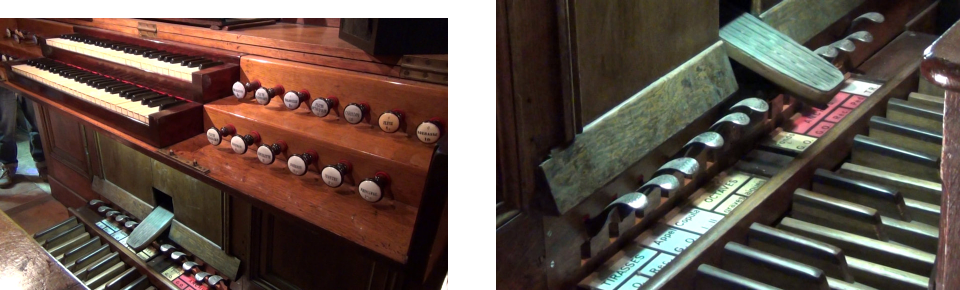
The organ was built by Merklin in 1893.
In 1970, Beuchet-Debierre extended the organ and
carried out a re-voicing of the piping (entrusted to J.
Picaud). On this occasion, new Plein Jeu stops were
added.
In 1988, additional work was carried out by Jacques
Barbéris and the Parisian Manufacture des Grandes
Organs with the aim of improving the instrument that
suffered from heating.
In 1990, Dargassies carried out a complete restoration
that corrected the 1970 re-voicing. Seven new stops
were added: Doublette 2' at GO, Fourniture/Cymbal at
GO; Flûte harmonique 8', Flûte octaviante4', Octavin 2'
and Carillon III at the Swell.
In 2010, Dargassies performed an overhaul.
1893 - Merklin (1)
1970 - Beuchet-Debierre (3a)
1988 - Barbéris (6)
1990 - Dargassies (4)
2010 - Dargassies (6)
II/26 - mechanical traction -
stoplist

Titular organist
Emmanuel Berenz
Parish website
Photo
Organ: Jeroen de Haan
Church: Vincent Hildebrandt








Organs of Paris


ORGANS OF PARIS © 2026 Vincent Hildebrandt
1893 - Merklin (1)
1970 - Beuchet-Debierre (3a)
1988 - Barbéris (6)
1990 - Dargassies (4)
2010 - Dargassies (6)
II/26 - mechanical traction -
stoplist
C3
The organ was built by Merklin in 1893.
In 1970, Beuchet-Debierre extended the organ and
carried out a re-voicing of the piping (entrusted to J.
Picaud). On this occasion, new Plein Jeu stops were
added.
In 1988, additional work was carried out by Jacques
Barbéris and the Parisian Manufacture des Grandes
Organs with the aim of improving the instrument that
suffered from heating.
In 1990, Dargassies carried out a complete restoration
that corrected the 1970 re-voicing. Seven new stops
were added: Doublette 2' at GO, Fourniture/Cymbal at
GO; Flûte harmonique 8', Flûte octaviante4', Octavin 2'
and Carillon III at the Swell.
In 2010, Dargassies performed an overhaul.

Titular organist
Emmanuel Berenz
Parish website
Photo
Organ: Jeroen de Haan
Church: Vincent Hildebrandt
